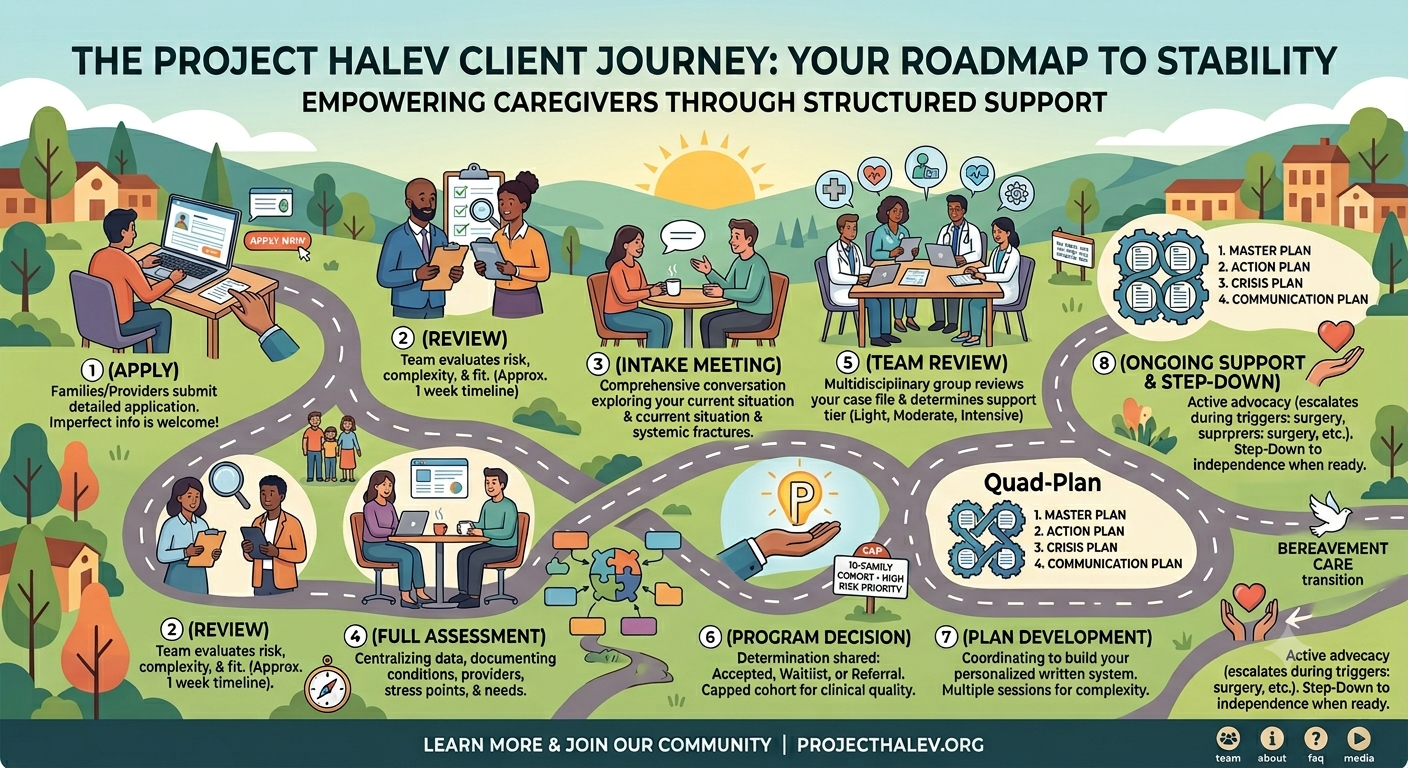

The 8-Step Journey
Step 1: Apply
Families or referring clinical providers submit a detailed application. This initial intake explicitly gathers details on diagnoses, active medical providers, daily care challenges, and specific public or private systems that have failed, been disrupted, or been denied. Empathy Note: The website will emphasize that imperfect, messy information is completely expected and okay.
Step 2: Review
The internal team carefully evaluates the application within approximately one week, though the timeline moves faster for highly urgent situations. The team assesses the current level of risk, medical complexity, support gaps, and whether the program is an appropriate fit.
Step 3: Intake Meeting
A comprehensive, face-to-face or virtual conversation is scheduled. Rather than a quick, superficial check, this deep dive explores exactly what is happening right now, where healthcare bureaucracy or insurance access is fracturing, and what is driving the immediate mental load.
Step 4: Full Assessment
The intake team maps the entire lifecycle of the family's needs into a centralized data set. This step leaves no assumptions or gaps, documenting every co-occurring condition, active provider structure, caregiver stress point, and advocacy need.
Step 5: Team Review
The collected case file is brought back to the internal multidisciplinary group. The team collaboratively reviews the case to determine the specific level of care required—categorized flexibly into Light, Moderate, or Intensive support tiers.
Step 6: Program Decision
A formal determination is shared with the family regarding program entry (acceptance, waitlist placement, or external resource referral). Because PHL values uncompromised clinical quality, launch capacity is strictly capped at a 10-family active cohort, prioritizing families at highest risk of caregiving collapse or unsafe hospital discharge.
Step 7: Plan Development
If accepted, PHL coordinates a dedicated planning phase with the family to construct a personalized Quad-Plan. Depending on medical complexity, this can take anywhere from one meeting to six or more intensive sessions. The written system consolidates information into four distinct documents:
The Master Plan: Consolidating conditions and active medical providers.
The Action Plan: Detailing short-term logistical goals and pending administrative tasks.
The Crisis Plan: Mapping unique emergency triggers and exact response protocols.
The Communication Plan: Defining checking schedules and team touchpoints.
Step 8: Ongoing Support & Step-Down
You didn’t come this far to stop
Contact Us
Reach out anytime—we're here to listen and help.
Help
Supporting caregivers and those they love.
Contact
Connect
Office@projecthalev.org